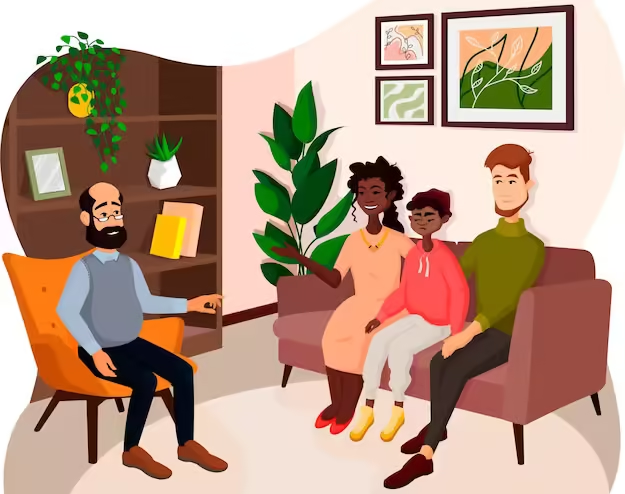
Family Therapy and Family Counseling in Dhaka
When the whole house feels tense, everyone is hurting, and talking only makes it worse. Family therapy helps families in Dhaka understand each other again.
Quick facts
| Who it is for | Parents, children, siblings, in laws and extended family dealing with conflict or a member who is unwell |
| Who attends | Flexible. Often parents first, others join when helpful |
| Approach | Systemic family therapy focused on patterns between people |
| Where | In person at the chamber in Monipuripara, Farmgate, Dhaka, or online by secure video call |
| Session length | 45 to 50 minutes |
| Languages | Bangla and English |
| Booking | WhatsApp +8801929446548. Fees are shared before you book |
What family therapy is
Family therapy looks at the problem as something happening between people, not inside one person. When a teenager stops talking, a parent becomes angry, or a household splits into sides, everyone is usually reacting to everyone else. Changing that pattern often helps far more than sending one family member to be fixed.
In Bangladesh, family is at the center of almost every decision, so family problems rarely stay small. That is also why families have so much power to help each other once the pattern changes.
When families come to me
- Constant arguments, silence or tension at home
- Conflict between parents and teenagers or young adults
- Joint family and in law tension
- Parenting disagreements between mother and father
- Supporting a family member with depression, OCD, psychosis, addiction or another mental health condition
- Separation or divorce and its effect on children
- Grief after a death in the family
- Family members separated by migration or work abroad
What the research says
Two major reviews by Alan Carr in the Journal of Family Therapy summarized the evidence for systemic family therapy and found it effective across a wide range of child focused and adult focused problems, including behavior problems in children, adolescent difficulties, substance use, relationship distress and supporting families of people with severe mental illness.
Locally, a 2025 study by Kawser and colleagues in the Journal of Marital and Family Therapy reported on the first university based family therapy clinic in Dhaka. Working with 46 families over a year, it found family therapy to be acceptable and valued by Bangladeshi families, which matches what I see in my own practice.
Supporting a family member with mental illness or addiction
When one person has depression, psychosis, bipolar disorder or an addiction, the whole family carries the strain. Relatives often swing between anger, guilt and exhaustion, and the person who is unwell feels watched or blamed. Family sessions help everyone understand the condition, agree on what helps and what does not, set fair boundaries, and look after the carers too.
Research consistently shows that involving families in care reduces relapse in severe mental illness. If hospital or rehab care is being considered, this guide to psychiatric hospitals and rehab facilities in Dhaka can help you plan.
How family sessions work
Not everyone has to attend every session. We start with whoever is willing, often parents first, and then bring others in when it is useful. In sessions I make sure each person gets space to speak, including the quieter members, while respecting the place of elders in the family.
Together we work on:
- Understanding the repeated cycle behind the fights
- Listening without immediately defending
- Clear, fair rules and roles at home
- Boundaries that protect the marriage and the children
- How to support a family member who is unwell without burning out
Family therapy, couple therapy or child therapy?
If the difficulty is mainly between husband and wife, couple therapy is usually the better starting point. If the concern is mainly a child or teenager, start with child and teen therapy, where parents are involved anyway. If several relationships at home are affected, family therapy makes sense. If you are not sure, message me and we can decide together.
When a family member needs hospital level care, this guide on psychiatric hospitals and rehab facilities in Dhaka may help you plan the next step.
Online family sessions
Families today are often spread across cities and countries. Members can join sessions by video call from wherever they are, which makes it possible to include a son working in the Middle East or a daughter studying abroad.
Helpful reads
About your psychologist
I am Alal, a psychologist based in Dhaka. I completed an MS in Clinical Psychology at the University of Dhaka, an MSc in Clinical and Counseling Psychology at Jagannath University, and postgraduate training in psychotherapy at the Department of Psychiatry, BSMMU. My work is grounded in evidence based approaches such as CBT, DBT skills and mindfulness based therapy, adapted to the realities of life in Bangladesh.
You can meet me at my chamber at Model Addiction and Psychiatric Care, 113/A, Monipuripara, Farmgate, Tejgaon, Dhaka 1215, or online from anywhere in Bangladesh or abroad. More about me.
Written and last reviewed by Psychologist Alal, October 2026.
বাংলায় সংক্ষেপে
পরিবারে নিয়মিত ঝগড়া, বাবা মা ও সন্তানের মধ্যে দূরত্ব, যৌথ পরিবারের চাপ, বা পরিবারের কোনো সদস্যের মানসিক অসুস্থতা সামলাতে আমি ঢাকায় এবং অনলাইনে ফ্যামিলি থেরাপি দিয়ে থাকি। সবাইকে প্রথম দিনেই আসতে হবে না। যোগাযোগ: হোয়াটসঅ্যাপ +8801929446548।
Common Questions About Family Therapy in Dhaka
No. Family therapy can start with whoever is willing, often one or both parents, and other members can join later when it is helpful.
Therapy can still help. When even one or two people change how they respond, the family pattern often shifts, and reluctant members sometimes join once they see the sessions are not about blaming them.
Yes. Children and teenagers can join sessions in an age appropriate way, and some sessions may be with parents alone so that adult topics stay between adults.
Couple therapy focuses on the relationship between two partners, while family therapy works with the wider household, such as parents, children, siblings or in laws.
It depends on the problem, but many families notice change within several sessions, with sessions often spaced every one to two weeks.
Yes. Family members can join online by video call from anywhere, so a family split across countries can still take part together.
Yes. Family therapy helps relatives understand addiction, stop patterns that unintentionally keep it going, set clear boundaries and support recovery alongside medical or rehab treatment.
A standard session lasts 45 to 50 minutes, in person at the Farmgate chamber or online, in Bangla or English.
Fees depend on the type of session, such as individual, couple, family or online, and are shared on WhatsApp before you book so there are no surprises. Message +8801929446548 to ask.


